
We tested the 5 most popular running socks.
This is the pair our experts preferred

You have probably heard runners and hikers talk about better shoes, thicker socks and special blister products. But when your feet start rubbing inside your shoe, the sock itself can make a bigger difference than most people realise.
Hot spots, damp feet and sore toes can turn a good run into an uncomfortable one. So we compared five popular running sock brands to see which ones actually delivered the best combination of comfort, fit, moisture control and friction reduction.
One pair stood out because it dealt with the problem that conventional socks leave behind: your toes rubbing together.


Key features of our winning running sock
Separates all five toes
Each toe has its own sleeve, helping reduce skin on skin rubbing and giving your toes more room to move naturally.
Helps manage moisture
The performance fabric is designed to help feet feel fresher and more comfortable while you are running.
Lightweight, secure fit
Kintoe sits closely inside your shoe without unnecessary bulk, slipping or bunching.
Coolmax and Merino Wool options
The Coolmax range is suited to warmer sessions, while the Merino Wool range gives runners a warmer option for cooler conditions.
But which running sock should you choose?
With so many running socks promising comfort, breathability and blister protection, it is easy to feel overwhelmed. The important thing is that not all running socks are designed to solve the same problem.
Most socks cover your toes together. That means your toes can still rub against each other, especially when your feet get warm or damp.
Five toe socks take a different approach. Each toe has its own section, helping to reduce contact and friction where it usually starts.
5 popular running socks put to the test
We compared five popular options using five criteria that matter to runners:
Toe separation and friction control:
whether the sock separates the toes and helps reduce skin on skin rubbing.
Moisture management:
how fresh and comfortable feet felt during movement.
Comfort and fit:
bulk, bunching, support and how each sock felt inside a running shoe.
Quality and performance:
the materials, construction and performance during regular use.
Price and value:
the price compared with the features and overall experience for regular runners.
We expected a close result, but one pair came out clearly ahead. Here is the full comparison.
🏆 #1: Kintoe
Our top-pick for 2025

🏆 #1: Kintoe
Our top-pick for 2025
Kintoe came out on top because it addresses the problem that most standard running socks ignore: contact between the toes.
The five toe design gives each toe its own sleeve, helping reduce skin on skin rubbing without adding unnecessary bulk. Our experts liked the lightweight feel, the secure fit and the way the sock stayed comfortable inside the shoe.
The Coolmax range is designed for performance and moisture management, while the Merino Wool range gives runners a warmer option for colder conditions.
Overall, Kintoe offered the best balance of toe separation, comfort, moisture management, quality and value.
🔥 Limited time offer: Buy 3, Get 3 Free.
If you are tired of dealing with hot spots and sore toes every time you run, Kintoe gives you a simple way to change the layer where the problem begins.
#2: Hollow Socks

#2: Hollow Socks
Hollow Socks has a lightweight feel and a simple performance construction. It is comfortable for shorter runs and everyday wear, but the one piece design leaves the toes together.
That means it does not directly address skin on skin rubbing between the toes. Our experts found it a reasonable option for general comfort, but less targeted for runners who regularly develop toe hot spots.
#3: Injinji
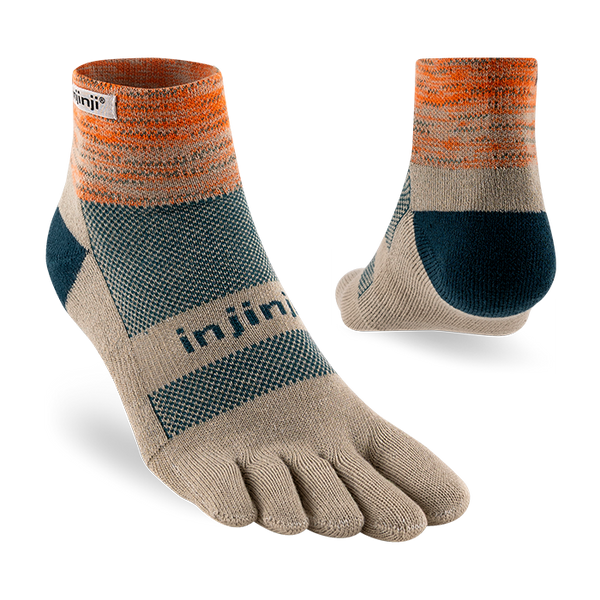
#3: Injinji
Injinji is the closest comparison because it also uses individual toe sleeves. The basic idea is strong and the design can help runners who want more separation between their toes.
However, our experts found that the fit and fabric feel varied between styles. It can also be a more expensive option for runners who want to build a regular rotation of socks.
#4: Feetures

#4: Feetures
Feetures is known for its close fit and targeted compression. The secure feel works well for many runners, but the toes remain together inside the sock.
For anyone whose main issue is toe to toe friction, compression around the foot does not directly address the source of the problem. It is a good conventional running sock, but it does not offer the same five toe construction as Kintoe.
#5: Balega

#5: Balega
Balega is popular for its cushioning and comfortable feel. That extra cushioning can work well for some runners, but it may create more bulk inside a close fitting shoe.
The conventional construction also leaves the toes in contact with one another. Balega is a comfortable everyday option, but it is less targeted for runners whose main concern is rubbing between the toes.
Why should you use a five toe running sock?
A conventional sock covers the toes together. When your feet get warm or damp inside your shoe, that contact can create rubbing and hot spots.
A five toe design gives each toe its own section. This helps reduce skin on skin friction and creates a more comfortable fit inside the shoe.
If toe rubbing is one of your main problems, changing the construction of the sock makes more sense than simply adding more padding.
Kintoe is designed to give runners a lightweight, secure and comfortable option that works with the way their feet move.
What to look for when choosing a running sock
Individual toe separation
If toe rubbing is one of your main problems, look for a five toe design that gives each toe its own section.
Lightweight construction
A good sock should feel secure inside your shoe without creating unnecessary bulk or pressure.
Moisture conscious fabric
Look for materials that help your feet feel comfortable during movement and suit the conditions you train in.
A fit that stays in place
Slipping and bunching can create extra rubbing, so the sock should stay secure throughout the run.
A design that matches your problem
If your issue is friction between the toes, choose a sock that is designed to address friction between the toes.
What to avoid in running socks
One piece construction when toe rubbing is the issue
A conventional sock cannot separate toes that it covers together.
Excessive bulk
Thick cushioning can make a close fitting shoe feel tighter and less comfortable.
Loose or bunching fabric
Movement inside the shoe can create additional rubbing and hot spots.
Vague promises without proof
Be cautious about dramatic claims that are not supported by clear materials, expert testing or a straightforward guarantee.
Are five toe socks really the solution for more comfortable running?
For runners whose main issue is toe to toe friction, the comparison suggests that separating the toes is a more targeted approach than simply adding more cushioning.
A five toe design gives the skin less opportunity to rub together. A close fitting, moisture conscious fabric can also help the sock feel more comfortable inside the shoe.
Across the comparison, one thing became clear. More padding is not always the answer. Sometimes the better solution is changing the construction completely.
The winner is clear...
After reviewing five popular running sock options, Kintoe was the clear winner for runners who want to reduce toe friction without sacrificing comfort or fit.
Its five toe design, lightweight construction and choice of Coolmax Performance and Merino Wool fabrics give runners a more targeted alternative to a conventional one piece sock.
If you are ready to stop accepting hot spots as part of every run, Kintoe is the clear choice.